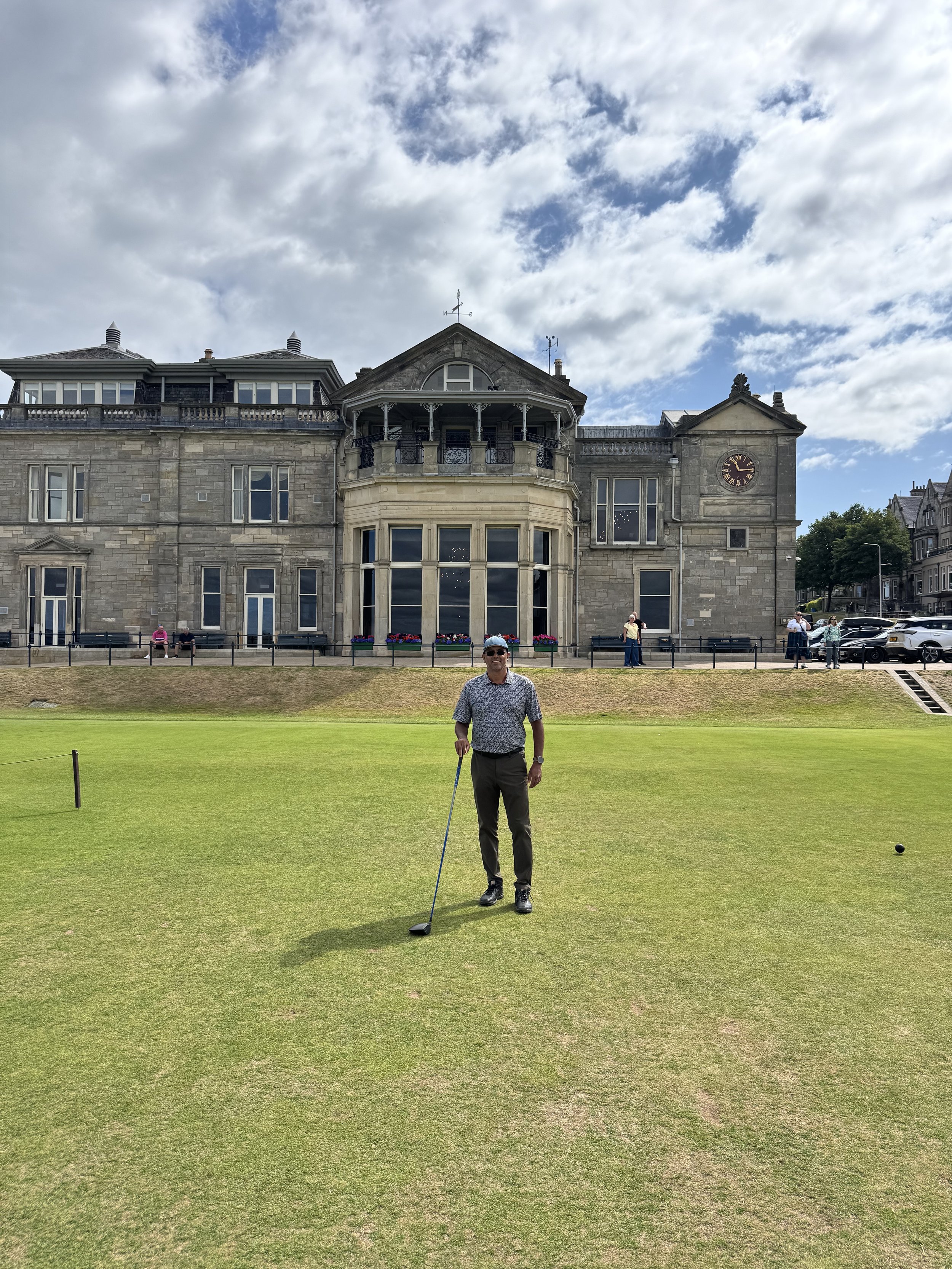
The Round of Gratitude
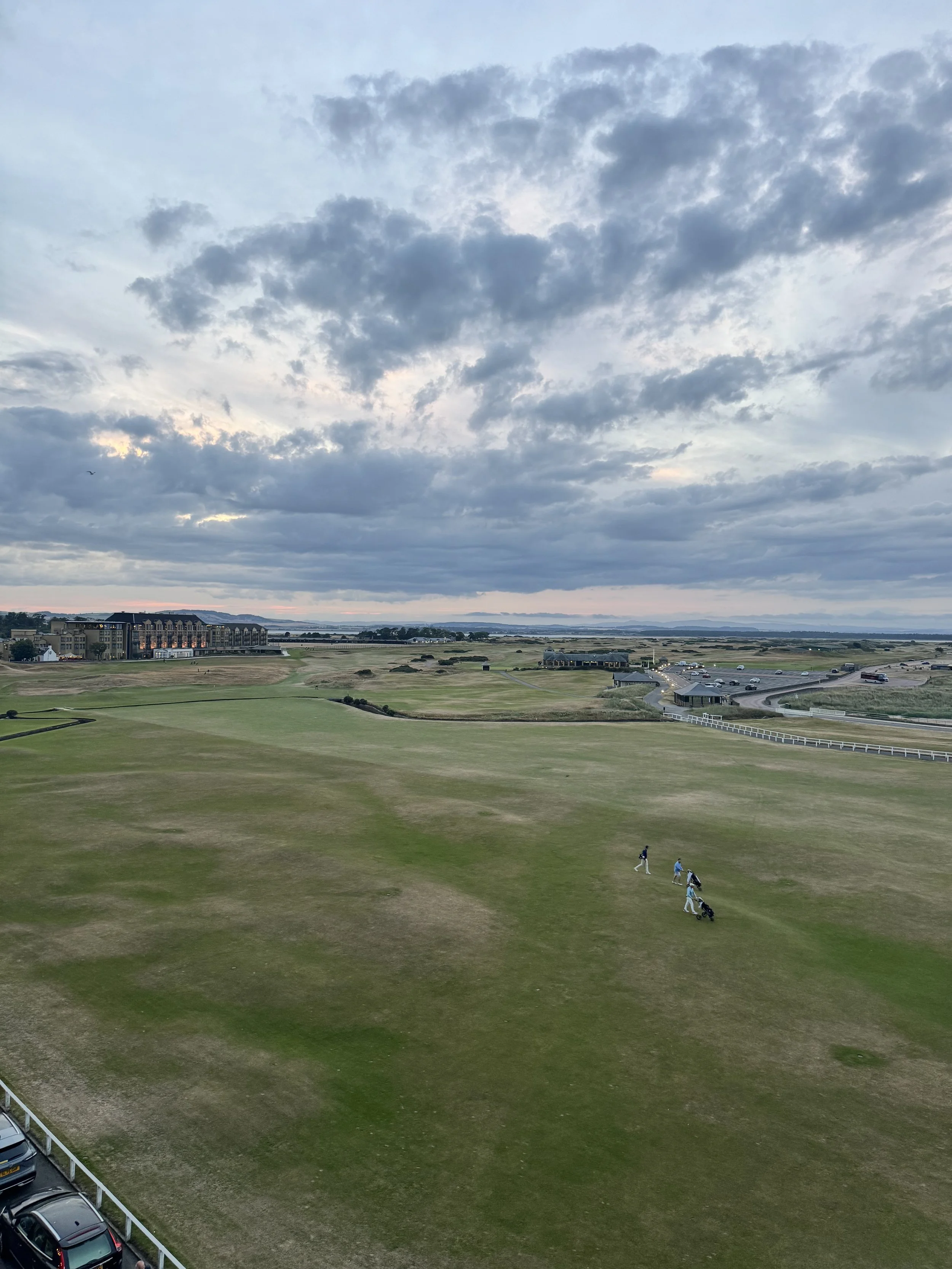
Looking on to the 18th from my room at Rusacks St.Andrews
There are some rounds of golf you remember because you played well.
There are others you remember because of where you played—the beauty of the course, the history beneath your feet, or the difficulty of the test.
And then, very rarely, there is a round that becomes something else altogether. The score begins to lose its importance. The shots become markers along a much longer journey. You look around and realize that you are not simply playing golf. You are standing inside a life you could never have planned for yourself.
For me, that was the round of gratitude.
Before I Knew Golf
When I was growing up in India in the 1980s, my mother had a cousin who lived in Chicago. He would visit us from time to time, arriving with his thick American accent and a great love for my mother’s cooking.
To a young boy in India, he seemed to come from another world.
By the early 1990s, when I was in college in Pilani, he had moved to New Delhi for work. His multinational company had rented him a home in one of the city’s posh neighborhoods—a centrally air-conditioned house, which itself felt like an unimaginable luxury in a Delhi summer.
One summer, he had to travel for about two weeks. His elderly mother, who used a wheelchair, lived with him. She had a full-time caregiver who attended to her needs, but he wanted a family member in the house while he was away. He asked me if I would stay there during my summer break.
Of course I said yes.
He had always been generous with me. When I came to Delhi from Pilani—a journey of roughly five hours—he would sometimes take me, and occasionally my friends, to a five-star hotel for lunch or dinner. We would eat, have drinks, and talk. During those visits, I gradually came to know more about his daily life.
One part of that life fascinated me: he was a golfer.
I knew almost nothing about golf. There was no internet to consult, no YouTube video to explain the game, and no easy way for a college student in Pilani to enter that world. I only had his stories.
He would tell me how much he had bet on each hole, how much he had won one day, or how much he had lost on another. I remember listening in amazement. The sums sounded enormous to me—not necessarily because they were enormous to him, but because I was a college student and they belonged to a scale of life far beyond my own.
I was not thinking, “One day, I will do that.”
I was simply thinking, “What is this game that makes someone wager so much money on a single hole?”
Golf was mysterious, distant, and completely outside the life I knew.
Thirty Years Later
Fast-forward more than thirty years.
I am a golfer.
Even writing that sentence fills me with wonder.
In July 2026, I traveled to Scotland on an extraordinary journey through the great Open venues. Over eight days, our group played Royal Troon’s Portland Course and Old Course, Prestwick, Turnberry’s Ailsa Course, the Castle Course at St Andrews, the Old Course at St Andrews, and finally Carnoustie.
These were not merely famous names on an itinerary. They were places where the history of golf felt alive.
At Royal Troon, the opening holes offered views toward the Isle of Arran and Ailsa Craig before the course revealed its teeth. Prestwick wound through rugged dunes, blind shots, and deep bunkers, carrying the spirit of golf’s earliest championships. At Turnberry, the holes ran along the water beside the lighthouse, the beauty almost competing with the challenge. The Castle Course looked back toward the medieval town of St Andrews from its dramatic clifftop setting. Carnoustie waited at the end, stern and uncompromising, its closing holes crossing the Barry Burn again and again.
And then there was the Old Course.
To stand on the first tee at St Andrews is to feel that you have arrived somewhere larger than a golf course. The fairways, the Swilcan Burn, the Road Hole, the Valley of Sin, and the walk up the eighteenth are familiar even before you play them. Generations of golfers have carried their hopes, fears, triumphs, and disappointments across that ground.
But as I stood there, my mind traveled somewhere else.
It went back to India.
It went back to that centrally air-conditioned house in Delhi.
It went back to the young college student listening to stories about a game he did not understand, wondering why anyone would bet so much money on a hole.
That young man could not have imagined this moment. He did not know that golf would one day become part of his own life. He could not have pictured himself crossing an ocean to Scotland, playing the great links, staying beside the Old Course, and walking up the eighteenth at the Home of Golf.
Yet there I was.
Who Brought Me Here?
We like to believe that we design our lives.
We make plans, set goals, work hard, and take credit when things go well. But when I look honestly at the journey from Pilani to St Andrews, I cannot claim authorship of it.
I did not plant the first image of golf in my own mind. I did not arrange every meeting, opportunity, friendship, success, failure, delay, and turn that eventually carried me there. I could not even have imagined the destination, much less charted the route.
The words of Bhagavan Sri Ramana Maharshi come to mind: the feeling “I am the doer” is itself the source of our burden. When that burden is surrendered, life is seen differently. Actions still happen. Journeys still unfold. A golf ball is still addressed and struck. But the anxious claim of personal authorship begins to loosen.
Standing at St Andrews, I did not feel, “Look what I have achieved.”
I felt, “How did You bring me all the way here?”
Everything that had happened until that moment had happened by the Lord’s grace. And whatever happens from this moment forward will also happen by the Lord’s grace.
That realization changed the round.
A Different Scorecard
Golf trains us to count everything.
We count strokes, putts, fairways, greens, penalties, handicaps, wins, and losses. My relative’s stories from Delhi had also been about counting—how much was won on one hole and how much was lost on another.
But on this round, I found myself keeping a different scorecard.
I counted the people who had helped me.
I counted the doors that had opened.
I counted the difficult moments that had redirected me.
I counted the blessings I had once taken for granted.
I thought of my mother and her cooking, of her cousin from Chicago, of his generosity to a college student, and of those conversations that introduced me to a game without either of us knowing what seed was being planted.
I thought of family, friends, teachers, colleagues, playing partners, and even strangers whose actions had quietly shaped my path.
The more I counted, the less room there was for pride.
There was only gratitude.
Not gratitude merely for an expensive trip or access to celebrated courses. Those were wonderful, but they were the outer form of the gift. The deeper gift was being allowed to see, even for a moment, how mysteriously a life unfolds.
Turning Inward
A golf course constantly pulls the attention outward: toward the wind, the bunkers, the flag, the lie, the score, and the other players. The mind evaluates every shot and immediately moves to the next desire or regret.
But the true round of gratitude turns the attention inward.
Who is delighted by this good shot?
Who is embarrassed by that poor one?
Who wants to possess the experience, display it, or say, “I did this”?
And beneath all those passing thoughts, who am I?
The quietest moments of the trip were therefore the most valuable. Between shots, while walking those ancient fairways, I could sense that the real destination was not Scotland. It was the silence beneath the mind—the Self that had been present in India, in Pilani, in Delhi, and now in St Andrews, unchanged while the scenery of life transformed around it.
The courses were magnificent. But even the greatest course is part of the passing world. The awareness in which the experience appears is closer, deeper, and more enduring.
The Final Hole
Every round ends.
The ball drops into the last cup. Hands are shaken. The scorecard is signed, discussed, or forgotten. Clubs are cleaned and packed away. Even a journey dreamed of for decades becomes a memory.
But gratitude need not end with the round.
Perhaps that is the real lesson golf has given me. We arrive at each tee with a plan, but the wind changes. The bounce surprises us. A perfect swing finds a bunker, while an imperfect shot somehow rolls close to the hole. We act, but we do not control the result.
So we play the shot in front of us.
We accept what comes.
We help our fellow travelers when we can.
We release greed, comparison, and the need to claim every outcome.
And we remember that we are not the Doer.
More than thirty years ago, I listened to a golfer’s stories without knowing where they would lead. In July 2026, I walked the links of Scotland with a golf club in my hands and gratitude in my heart.
The distance between those two moments cannot be measured in miles.
It can only be measured in grace.
And so, when I think of that extraordinary journey, I do not remember my score first.
I remember the Lord’s hand.
That was my round of gratitude.